
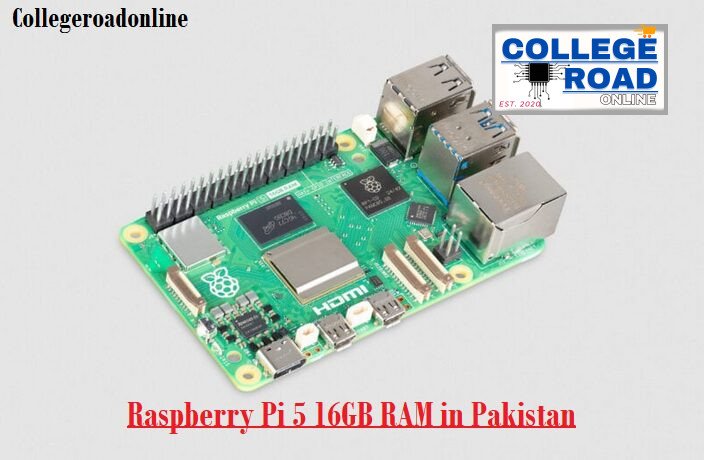
DescriptionRaspberry Pi 5 16GB — The Ultimate 16 Gigabyte Single-Board ComputerThe Raspberry Pi 5 16GB is the most powerful model in the Raspberry Pi family. It brings faster performance, more memory, and improved connectivity to makers, developers, and professionals. With 16 gigabytes of RAM, it is ideal for heavy multitasking, edge AI, media servers, or complex development projects. In short, it is a small computer with huge potential.Key Features & HighlightsFaster processor: A Broad-com BCM2712 quad-core Arm Cortex-A76 CPU at 2.4 GHz delivers two to three times more performance than the Raspberry Pi 4.Generous memory — With 16 GB LPDDR4X-4267, this Pi supports memory-intensive workloads like virtualization, large datasets, container clusters, and heavier multitasking. Raspberry Pi Datasheets 2Raspberry Pi 2Better graphics: A Video-core VII GPU supports dual 4Kp60 HDMI output with HDR, making it perfect for media centers and modern displays.Raspberry Pi Datasheets 2Raspberry Pi 2Improved I/O: The RP1 I/O controller doubles USB and SD card bandwidth compared to previous models. Raspberry Pi Datasheets 2Raspberry Pi 2PCIe expansion: A PCIe 2.0 x1 lane allows you to connect NVMe SSDs or other high-speed accessories. Raspberry Pi Datasheets 2Raspberry Pi 2Improved camera/display — The board features two 4-lane 1.5 Gbps MIPI transceivers, enabling multiple high-resolution cameras or displays simultaneously. Raspberry Pi Datasheets 2The Pi Hut 2Built-in peripherals & networking — The Pi includes dual-band 802.11ac Wi-Fi, Bluetooth 5.0 / BLE, Gigabit Ethernet (Poe-capable with HAT), plus 2× USB3.0, 2× USB2.0, micro SD slot, a 40-pin GPIO header, and more. Tom’s Hardware 4Raspberry Pi Datasheets 4Raspberry Pi 4 Why 16 GB MattersWhile lower-memory variants of Pi 5 exist (2GB, 4GB, 8GB), the 16 GB version is designed for power users who demand ample memory headroom. Use cases where 16 GB shines include:Running multiple Docker containers, virtual machines, or Kubernetes clustersManipulating large datasets or in-memory databasesMedia encoding/transcending workloadsMachine learning, AI inference, or computer vision pipelinesComplex emulation, game development, or 3D rendering tasksLong sessions with dozens of browser tabs or heavy desktop useThat said, for lighter or embedded projects, smaller RAM variants may suffice. In performance benchmarks, reviewers note that the only difference between Pi 8 GB and Pi 16 GB is memory size; other hardware features remain identical. Tom’s HardwarePerformance ScenariosDesktop replacement: With enough RAM, dual 4K displays, and fast I/O, the Pi 5 16GB can serve as a capable, low-power desktop for web, coding, productivity, and light office use.Server & NAS duties: Pair it with an NVMe SSD over PCIe and reliable cooling, and it becomes a compact, silent file server or media server.Edge AI / inference nodes: Use the extra memory and fast I/O to host models or run inference at the edge in robotics or vision projects.Industrial / automation: The robust design, RTC, and I/O make it suitable for industrial control, data logging, and integrated automation systems.Hobbyist / maker projects: From retro gaming consoles and emulators to home automation hubs and network appliances, the extra memory offers room to grow.Technical Specifications (Highlights)CPU: 4 × Arm Cortex-A76 @ 2.4 GHzGPU: Video Core VII supporting OpenGL ES 3.1, Vulcan 1.2RAM: 16 GB LPDDR4X-4267Dual micro HDMI for 4Kp60 outputRP1 controller doubling USB / SD throughputPCIe 2.0 x1 for expansionWi-Fi 5 (802.11ac), Bluetooth 5.0 / BLEGigabit Ethernet (PoE via HAT)micro-SD slot (SDR104 high-speed mode)40-pin GPIO header (backwards-compatible)Power: USB-C 5 V / 5 A (PD support)RTC, power button, fan headerProduction support through 2036Considerations & Best PracticesCooling is essential: Under sustained load, the Pi 5 can generate heat. Use a heat sink, fan, or active cooler to maintain performance and longevity.Power supply: Use a quality 5 V, 5 A USB-C supply (ideally 27 W or higher) to ensure stable operation under load.Compatibility with Pi 4 cases: Pi 4 enclosures generally will not fit due to changes in layout and cooling; use Pi 5-specific cases. Adafruit 1Operating system support: Use the latest Raspberry Pi OS (Bookworm release or newer) to ensure full compatibility and performance. Older OS versions may not fully support Pi 5’s new architecture. Raspberry Pi 1Use of full resources: To fully benefit, design your software or workflows to utilize multiple cores, parallelism, and the extra memory—don’t bottleneck at single-thread or I/O.
Related products
$ 20.27
This product has multiple variants. The options may be chosen on the product page 
$ 19.61
This product has multiple variants. The options may be chosen on the product page 
$ 97.67
This product has multiple variants. The options may be chosen on the product page 
$ 91.60
This product has multiple variants. The options may be chosen on the product page 
$ 26.51
This product has multiple variants. The options may be chosen on the product page 
$ 17.83
This product has multiple variants. The options may be chosen on the product page 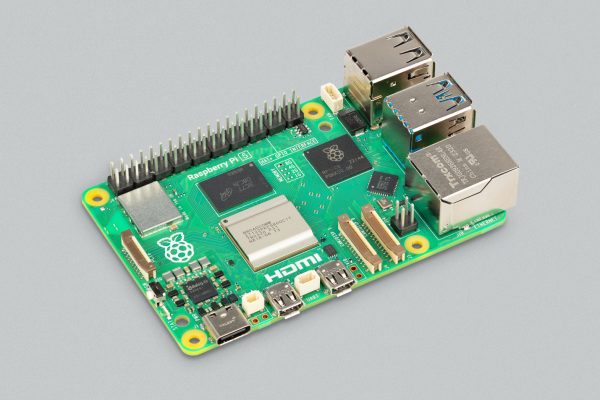
$ 62.59
This product has multiple variants. The options may be chosen on the product page 
$ 7.69
This product has multiple variants. The options may be chosen on the product page 
$ 6.90
This product has multiple variants. The options may be chosen on the product page 
$ 27.45
This product has multiple variants. The options may be chosen on the product page 
$ 19.61
This product has multiple variants. The options may be chosen on the product page 
$ 86.28
This product has multiple variants. The options may be chosen on the product page 
$ 31.22
This product has multiple variants. The options may be chosen on the product page 
$ 4.55
This product has multiple variants. The options may be chosen on the product page 
$ 90.34
This product has multiple variants. The options may be chosen on the product page 
$ 10.82
This product has multiple variants. The options may be chosen on the product page